How to Pivot to an AI-Native Company: A Practical Framework for Leaders
Learn the difference between AI slop and true AI-native transformation, plus a 4-step framework to redesign your company around AI capabilities.
AIProductivity
Featured image
Every company now claims to be "AI-powered." Most are lying, not maliciously, but to themselves.
They added a chatbot to their support page, connected GPT to their docs, or started generating blog posts with Claude. They checked the AI box on their investor deck and moved on. But bolting AI onto existing processes does not make you an AI-native company. It makes you the same company with a slightly shinier veneer.
The difference between AI-enabled and AI-native is the difference between putting a motor on a horse carriage and building a car. One is an upgrade. The other is a redesign from first principles.
Here's a practical framework for making the real pivot.
AI Slop vs. AI-Native: A Litmus Test
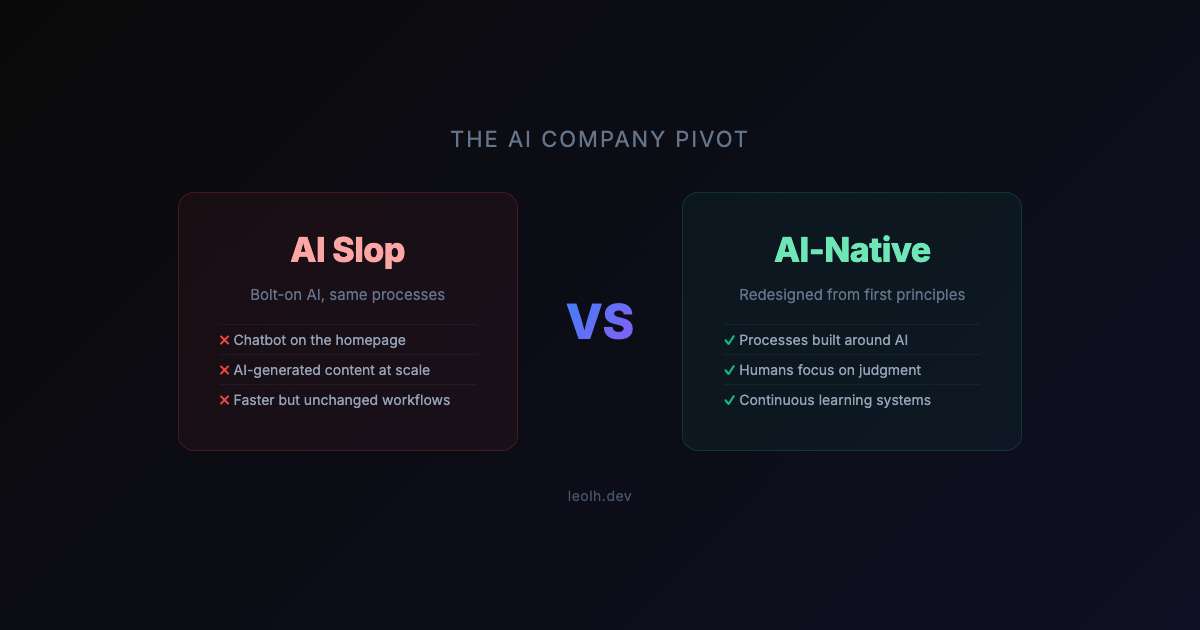
Before diving into how, you need to understand what you're aiming for. Most companies fall into what I call "AI slop" territory, surface-level AI adoption that looks impressive in demos but creates minimal value.
AI slop looks like:
A chatbot that answers FAQs but can't resolve actual issues
AI-generated content published without human judgment or editing
Automating individual tasks while leaving the surrounding workflow untouched
Using AI to do the same work faster instead of doing fundamentally different work
AI-native looks like:
Processes designed around AI capabilities that didn't exist two years ago
Humans focusing on judgment, taste, and strategy while AI handles execution and analysis
Data flowing continuously between AI systems and human decision-makers
New products and services that are only possible because of AI, not just cheaper
The litmus test is simple: if you removed the AI from your workflow, would the process still make sense? If yes, you're AI-enabled at best. If removing the AI would break the entire workflow because it was designed around AI capabilities, you're AI-native.
Step 1: Audit Your Workflows for Redesign Potential
Don't start by asking "where can we add AI?" Start by asking "which of our processes were designed for a world without AI?"
The answer is almost certainly: all of them.
Pick your three highest-value workflows. For each one, answer these questions:
What decisions are being made? Map every decision point, from who approves what to how information flows between people.
What's the bottleneck? Is it data gathering, analysis, creation, review, or coordination?
What would this look like if AI could do 80% of the execution? Not "how do we speed up step 3" but "what would we build if we started from scratch today?"
This audit usually reveals that your processes are shaped by historical constraints (limited human bandwidth, slow information access, manual data processing) that AI has already removed. You're operating within walls that no longer exist.
Step 2: Redesign Processes Around AI Capabilities
This is where most companies fail. They try to insert AI into existing workflows instead of redesigning the workflow entirely.
Example: Content production
The AI-enabled approach: Writers use AI to draft articles faster. An editor reviews and publishes them. Same process, slightly faster.
The AI-native approach: AI continuously monitors your analytics, competitor content, and audience questions to identify content opportunities. It produces first drafts with SEO structure, internal linking, and data citations already embedded. A human content strategist reviews for brand voice, adds original insights, and makes editorial judgment calls. AI then handles distribution, A/B tests headlines, and feeds performance data back into the next cycle.
The second version isn't "content creation with AI help." It's a fundamentally different content operation where the human role has shifted from production to strategy and taste.
Apply this pattern to your workflows:
Start from the outcome. What result does this process produce?
Design the AI-first version. If AI handled all execution, what would humans focus on?
Identify the human judgment points. Where do taste, ethics, strategy, and relationship-building matter?
Build the feedback loop. How does output quality flow back into the system to improve over time?
Step 3: Restructure Teams Around AI-Augmented Roles
An AI-native company doesn't have the same org chart with AI tools added. The roles themselves change.
The shift follows a consistent pattern:
Doers become reviewers. People who previously spent 80% of their time on execution now spend 80% on review, quality control, and strategic direction.
Specialists become generalists. When AI handles the technical execution of design, code, analysis, or writing, the value shifts to people who can work across domains and connect dots.
Managers become system designers. Instead of managing people doing tasks, leaders design the AI-human systems that produce outcomes.
Practical steps:
Rewrite job descriptions around judgment and oversight, not execution. "Review and refine AI-generated analyses" instead of "Produce weekly reports."
Invest in AI fluency, not AI expertise. Everyone needs to know how to direct AI effectively. You don't need a team of prompt engineers. You need a company of people who understand what AI can and can't do.
Measure output, not activity. When AI multiplies individual output by 5-10x, hours worked becomes meaningless. Track outcomes and quality instead.
Step 4: Build the Feedback Infrastructure
AI-native companies are learning systems. The AI gets better over time because you designed feedback loops into every process.
This means:
Capture corrections. Every time a human overrides or edits AI output, that correction should feed back into the system. Whether it's fine-tuning, updating prompts, or adjusting guardrails, the system must learn.
Track AI-specific metrics. Measure AI output quality, human override rate, time-to-value for AI-assisted processes, and cost per output. These metrics tell you whether your AI adoption is actually working.
Version your prompts and workflows. Treat your AI workflows like software. Version them, test changes, and roll back when something degrades quality.
Schedule regular process reviews. AI capabilities evolve fast. A workflow you designed six months ago might be obsolete because a new model can handle steps you assumed needed humans. Review quarterly at minimum.
The Mistakes That Kill AI Pivots
Three patterns I see repeatedly in companies that fail at this:
Mistake 1: Automating without redesigning. They speed up a bad process instead of building a good one. A 10x faster version of a flawed workflow just produces flawed output at scale.
Mistake 2: Treating AI as a cost-cutting tool only. If your AI strategy is "do the same things with fewer people," you'll save money short-term and lose to competitors who used AI to do entirely new things.
Mistake 3: Waiting for perfect AI before committing. The models will always be improving. Companies that wait for AGI to "do it right" will be outpaced by companies that built learning systems around today's imperfect AI and improved iteratively.
Where to Start Tomorrow
You don't need to transform your entire company at once. Pick one workflow, ideally one that's high-value and clearly bottlenecked by human bandwidth.
Run the audit from Step 1. Redesign it from scratch using Step 2. Adjust the team roles per Step 3. Build the feedback loop from Step 4.
Give it 90 days. Measure the results. Then expand to the next workflow.
The companies that will dominate the next decade aren't the ones with the best AI models. They're the ones that redesigned how they work around what AI makes possible. That's what it means to be an AI-native company. And the pivot starts with one process, redesigned from first principles.